Lecture1
Introduction
An algorithm is any well-defined computational procedure that takes some value, or set of values, as input and produces some value, or set of values, as output. An algorithm is thus a sequence of computational steps that transform the input into the output.
What's more important the performance
- correctness
- programmer time
- maintainability
- robustness
- user-friendlinness
Why study algorithms and performance
- what is feasible and what is impossible
- understand scalability
- \(O(n)\),\(O(n \log n)\)
- mathematical language
- generalize to other computing resources
Questions
- Given a problem, can we find an algorithm to solve it?
- Not always!
- Hibert's 10th Problem: Is a indefinate equation with natural number coefficients has a solution?
- What is a good algorithm
- Time!
- In polynomial of input length time
- Is a "good" algorithm always exist?
- Computational complexity theory
- \(P\) versus \(NP\)
- poly time solvable versus poly time checkable
The problem of sorting
Question
What is the lower bound of comparisions in the worst case to find both the maximum and minimum
Question
What is the lower bound of comparisions in the worst case to find the second minimum
Insertion sort
Best-case
The best case occurs if the array is already sorted
linear function
Worst-case
If the array is in reverse sorted order, the worst case results
quadratic function
- The running time depends on input
- Generally, we seek upper bounds on the running time, because everybody likes a guarantee
Machine-independent time
Randon-access machine(RAM) model
- No concurrent operations
- Each instruction takes a constant amount of time
Note
- Ignore machine-dependent constants
- Look at the growth of \(T(n)\) as \(n \to \infty\)
Notation
Definition
Asymptotically tight bound
Definition
- \(O\) -notation: asymptotically upper bound
- \(\Omega\) -notation: asymptotically lower bound
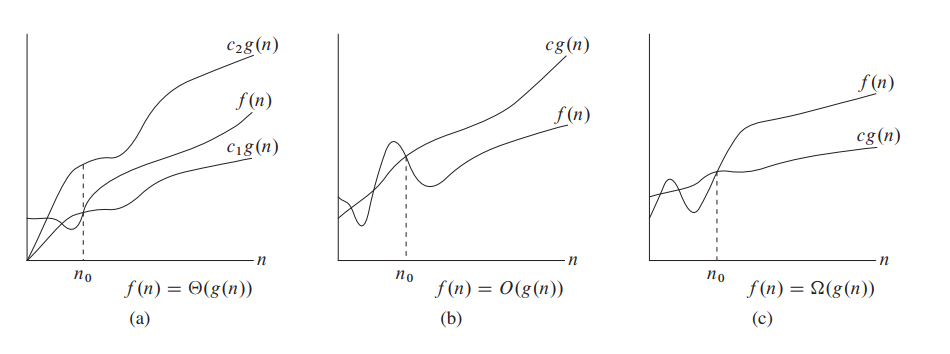
Question
Definition
Intuitively: \(\lim_{n \to \infty} \frac{f(n)}{g(n)} = 0\)
Definition
Intuitively: \(\lim_{n \to \infty} \frac{f(n)}{g(n)} = \infty\)
This notation has the properities
- Transitivity
- Reflexivity
- Symmetry
- Transpose symmetry
Standard notations and common functions
- Floors and ceilings
- Logarithms
- Stirling's approximation
-
\[ n! = \sqrt{2 \pi n} (\frac{n}{e})^n ( 1 + \Theta(\frac{1}{n}))\]
-
\[\log(n!) = \Theta(n \log n)\]
-
Functional iteration
The iterated logarithm function
there may \(10^80\) particles in the universe
Question
Which is asymptoically larger?
\(\log(\log^n)\) or \(\log^*(\log n)\)
the answer is the \(\(\log^*(\log n)\)\), consider a tower of power of 2 with height \(k\), the first is \(\log k\) and the second is \(k\)