Lecture 8
Knapsack problem
knapsack problem
- 0-1 knapsack problem
- Fractional knapsack problem
Given \(n\) items, the \(i\)th item is worth \(v_i\) dollars and weights \(w_i\) pounds, where \(v_i\) and \(w_i\) are integers. Give a knapsack with capacity \(W\) pounds, how to get a load with most valuable items?
- Greedy selection only works on Fractional knapsack problem
Huffman codes
Definition
A variable-length code can do considerably better than a fixed-length code
Prefix(-free) codes: The codes in which no codeword is also a prefix of some other codeword
Huffman
give frequent characters short codewords and infrequent characters long codewords
Cost
\(d_T(c)\) is the depth of \(c\) in the tree \(T\)
Constructing a Huffman code
for i = 1 to n-1
    allocate a new node z
    z.left = x = EXTRACT-MIN(Q)
    z.right = y = EXTRACT-MIN(Q)
    z.freq = x.freq + y.freq
    INSERT(Q,z)
return EXTRACT-MIN(Q)
Correctness of Huffman's Algorithm
Idea
Prove the greedy selcetion is "safe"
Lemma
Let \(C\) be an alphabet in which each character \(c \in C\) has frequency \(c.freq\). Let \(x\) and \(y\) be two characters in \(C\) having the lowest frequencies. Then there exists an optimal prefix code for \(C\) in which the codewords for \(x\) and \(y\) have the same length and differ only in the last bit
"The greedy selection properity"
Proof
We prove the lemma by construction. Convert a optimal solution to another optimal solution with the given prop in the lemma.
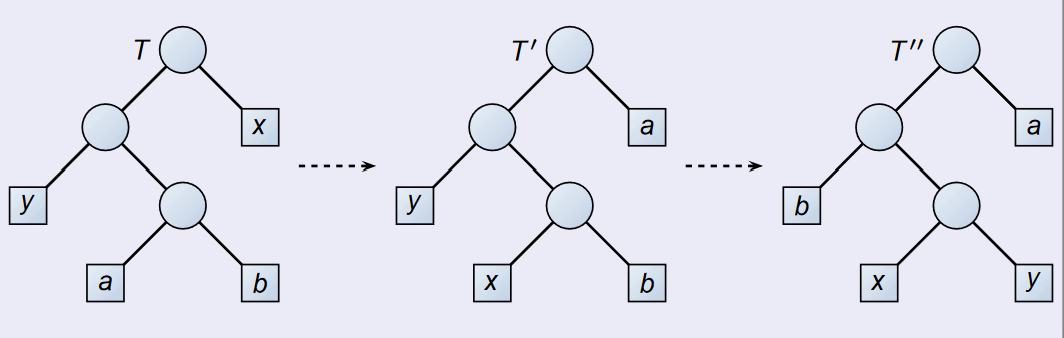
Lemma
Let \(C' = \{C - \{x,y\}\} \cup \{z\}\), where \(z.freq = x.freq + y.freq\). Let \(T'\) be any tree representing an optimal prefix code for alphabet \(C'\). Then the tree \(T\), obtained from \(T'\) by replacing the leaf node for \(z\) with an internal node having \(x\) and \(y\) as children, represents an optimal prefix code for the alphabet \(C\).
Proof
\(B(T) = B(T') + x.freq + y.freq\)
"Optimal substructure"
Theorem
Procedure HUFFMAN produces an optimal prefix code.
Proof
Corollary of the two lemmas
Matroids
Definition
A matroid is an ordered pair \(M = (S, \mathcal{I})\) satisfying the following conditions.
- S is a finite nonempty set
- \(\mathcal{I}\) is hereditary: \(\mathcal{I}\) is nonempty family of subsets of \(S\), called the independent subset of \(S\), such that if \(B \in \mathcal{I}\) and \(A \subset B\) the \(A \in \mathcal{I}\). Obvious \(\emptyset \in \mathcal{I}\)
- if \(A,B \in \mathcal{I}\) , and \(|A| < |B|\), then there is some elements \(x \in B \setdiff A\) such that \(A \cup \{x\} \in \mathcal{I}\). exchange property
Example
Graphic matroid.
Definition
Give a matroid \(M = (S ,\mathcal{I})\), we call an element \(x \notin A\) an extension of \(A\) \in \mathcal{I}$ if \(x\) can be added to \(A\) while preserving independence; that is \(x\) is an extension of \(A\) if \(A \cup \{x\} \in \mathcal{I}\)
- \(A\) is maximal if it has no extensions.
Theorem
All maximal independent subsets in a matroid has the same size
Example
Spanning tree is the maximal set in the Graphic matroid.
Weighted Matroid
a strictly positive weight \(w(x)\) to each element \(x \in S\).
\(w(A) = \sum_{x \in A} w(x)\)
- Why weighted matroid
- Many problems for which a greedy approach provides optimal solutions can be formulated in terms of finding a maximum-weight independent subset in a weighted matroid.
- Example: Minimum-spanning-tree problem
Greedy algorithm on a weight matroid
A = \emptyset
sort M.S into monotonically decreasing order by weight w
for each x in M.S, taken in monotonically, decreasing order by weight w(x)
    if A \cup {x} \in M.I
        A = A \cup {x}
return A
This is an \(O(n \lg n + n(f(n))\) algorithm, f(n) is the complexity of judging independence.
Correctness of the Algorithm
Lemma
Matroids exhibit the greedy-choice property
Prove by construction !!!
Lemma
Let \(M = (S, \mathcal{I})\) be any matroid. If \(x\) is an element of \(S\) that is an extension of some independent subset \(A\) of \(S\), then \(x\) is also an extension of \(\emptyset\).
Let \(M = (S, \mathcal{I})\) be any matroid. If \(x\) is an element of \(S\) such that \(x\) is not an extension of \(\emptyset\), then \(x\) is not an extension of any independent subset \(A\) of \(S\).
Lemma
Matroids exhibit the optimal-substructure property
Correctness of the greedy algorithm on matroids
If \(M = (S, \mathcal{I})\) is a weighted matroid with weight function \(w\) , then \(GREEDY(M, w )\) returns an optimal subset.
A task-scheduling problem
scheduling unit-time tasks with deadlines and penalties for a single processor
- Define the concept of independent: If there exists a schedule for these tasks such that no tasks are late.