Lecture4: Search 3
Adversarial Search
Minimax Algorithm
Minimax Values
- MAX nodes: Under Agent's Control
- MIN nodes: Under Opponent's Control

Tic-Tac_Toe Game Tree

Minimax Algorithm
- Minimax values: the best achievable utility against a rational(optimal) adversary
- Minimax search:
Minimax Properties
\[ V(\pi_{max}, \pi_{min}) \leq V(\pi_{max}, \pi_{opp}) \quad \forall \pi_{opp}\]
\[ V(\pi_{max}, \pi_{min}) \leq V(\pi_{agent}, \pi_{opp}) \quad \forall \pi_{agent}\]
Generalized Minimax
multiple players
- Generalization of minimax
- Each player maxmizes its own component
Minimax Efficiency
-
How efficient is minimax
- Just like (exhaustive) DFS
- Time: \((b^m)\)
- \(b\): The "branch factor"
-
Chess: \(b \approx 35\), \(m \approx 100\)
- Exact solution is completely infeasible
Alpha-Beta Pruning
$a = $best option so far from any MAX node on this path.
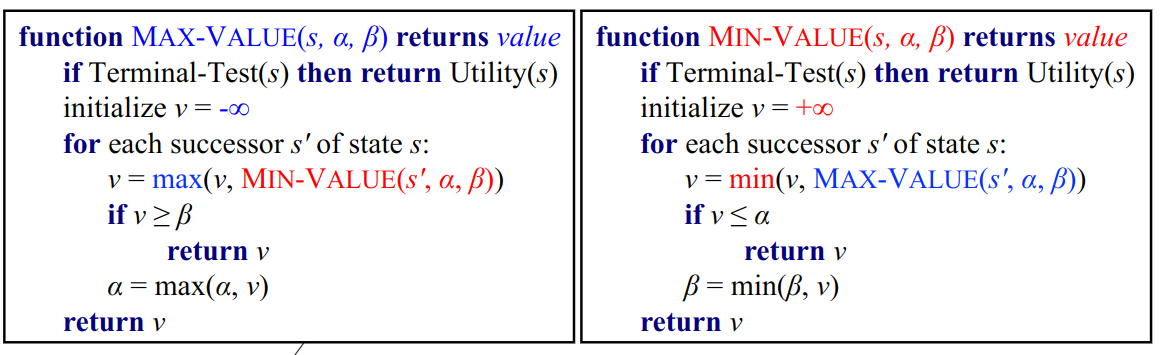
Theorem
This Pruning has no effect on minmax value computed for the root.
-
Move ordering
- Worst ordering: \(O(b^m)\) time
- Best ordering: \(O(b^{0.5m})\) time
- Random ordering: \(O(b^{0.75m})\) time
-
evaluation function Eval(s)
- MAX nodes: order successors by decreasing \(Eval(s)\)
- MIN nodes: order successors by increasing \(Eval(s)\)
-
Iterative deepening also helps
Real-Time Decisions
Resource Limits in Realistic Games
Evaluation Function
- Or a more complex nonlinear function (e.g. Neural Network)
Cutting off Search
Quiescence Search
- Terminate search only in quiescent positions
Games with Uncertain Outcomes
Chance node in the Trees
Minimax -> Expectimax
Monte Carlo Tree Search
Go: Failure for Alpha-Beta
- Lack of a good evaluation function
- Alpha-beta search limited to onlt 4 or 5 plies
Monte Carlo Tree Search (MCTS)
- Evaluation by rollouts
- Selective search
Upper Confidence Bound
Maximize: UCBI formula

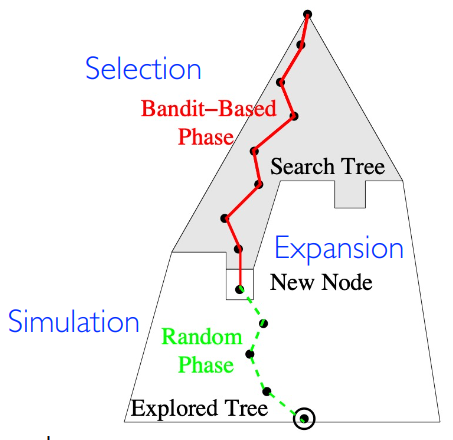
MCTS
- Selection
- Pick according to UCB
- Expansion
- Used when we reach the frontier
- Simulation
- Don't bother with UCB, just play randomly
- Backpropagation
MCTS: Selection
\[ UCB1(n) = \frac{U(n)}{N(n)} C \times \sqrt{\frac{\log N(Parent(n))}{N(n)}} \]
\(U(n):\) the total utility of rollouts that went through node \(n\)
MCTS: Backpropagation
- Update \(U(n)\) and \(N(n)\)