Lecture 5
Sorting in Linear Time
Decision-tree Model
A decision tree can model the execution of any comparison sort:
- View the algorithm as splitting whenever it compares two elements.
- The tree contains the comparisons along all possible instruction traces.
- The running time of the algorithm = the length of the path taken
- Worst-case running time = height of tree
Theorem
Any decision tree that can sort \(n\) elements must have height \(\Omega(n\lg n)\)
Counting sort
Definition
- Assumption: Each of \(n\) input elements is an integer in the range between \(0\) and \(k\)
- Aim: Runs in \(\Theta(n) time\)
- Input: \(A[1\cdots n]\), where \(A[j] \in \{0, 2, \cdots, k\}\)
- Output: \(B[1\cdots n]\), sorted
- Auxiliary storage: \(C[0\cdots k]\)
This algorithm is too easy, but need to analysis.
Stable sorting
Counting sort is a stable sort: it preserves the input order among equal elements
Radix sort
- Sort on least-significant digit first with auxiliary stable sort
- By counting sort
Correctness of radix sort
- Assume that the numbers are sorted by their low-order \(t-1\) digits
- Sort on digit \(t\)
- Two numbers that differ in digit \(t\) are correctly sorted
- Two numbers equal in digit \(t\) are put in the same order as the input
Analysis of radix sort
- Auxiliary stable sort.
- Sort \(n\) computer words of \(b\) bits each.
- Each word can be viewed as having \(b/r\) base-\(2^r\) digits.
The question is that how many passes \(r\) should we make?
- Counting sort takes \(\Theta(n + k)\) time to sort \(n\) numbers in the range from \(0\) to \(k - 1\)
Since there are \(b/r\) passes, we have
Choose \(r\) to minimize \(T(n,b)\),\(r = \lg n\) implies
Amazing Result!
Bucket Sort
Idea
Assume the input array \(A\) is generated by a random process that distributes elements uniformly over the inverval \([0,1)\)

Analysis of bucket sort
We define the indicator random variables \(X_{ij} = 1_{A[j]\text{falls in bucket } i}\). Thus \(n_i = \sum_{j=1}^n X_{ij}\)
Use some tedious math
And the result is
The bucket sort will run in linear time.
Medians and Order Statistics
Selection in expected linear time
Define the indicator random variable \(X_k\),if the subarray has excatly \(k\) elements
Then take the expectation and calculate ..., the math in CLRS is too annoying.
Selection in worse-case linear time
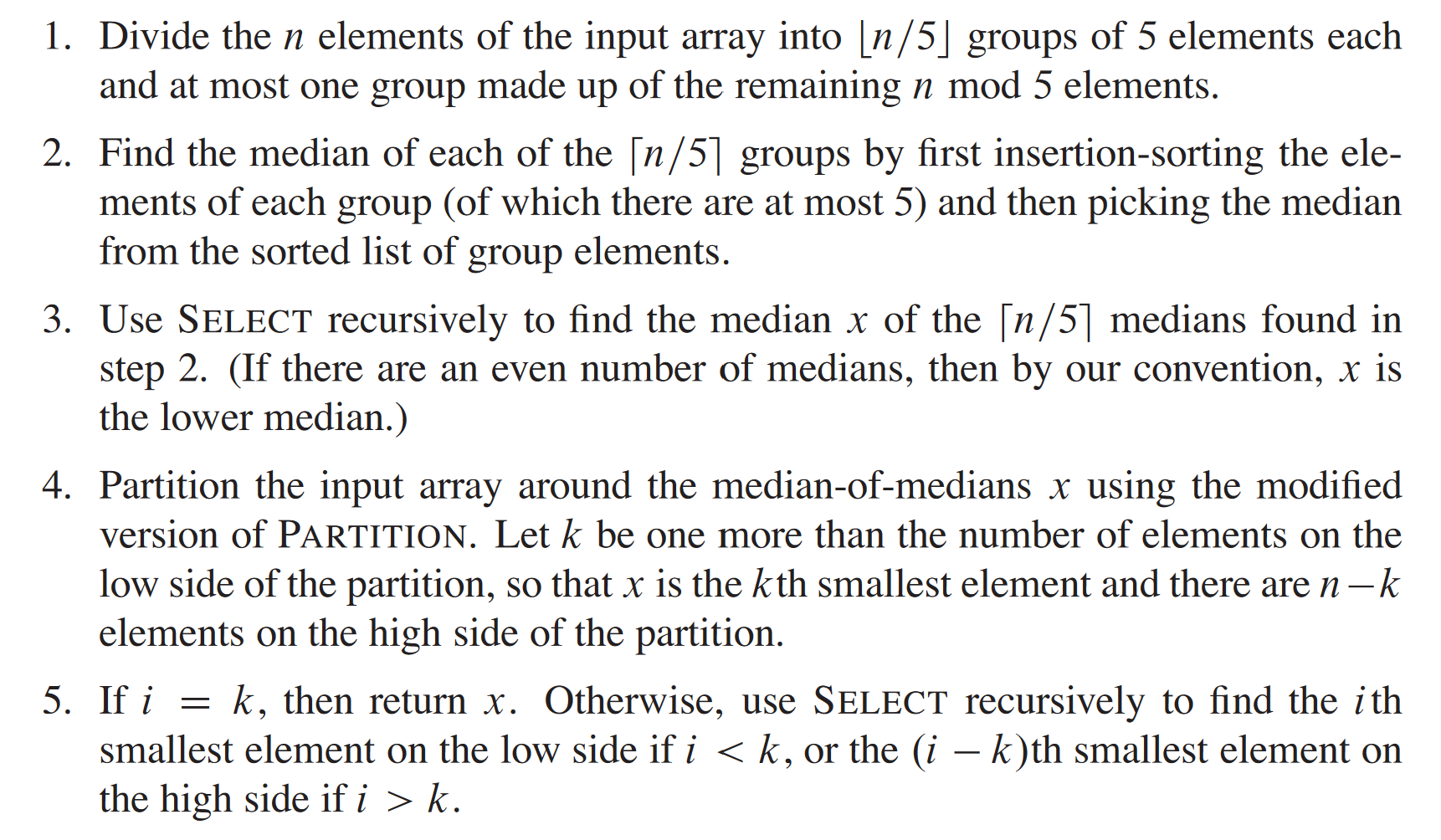
The Key idea in the proof can be described in the following picture

Warning
The median just used for selection. This algorithm can be used in \(O(n)\) \(k\)-th element algorithm